
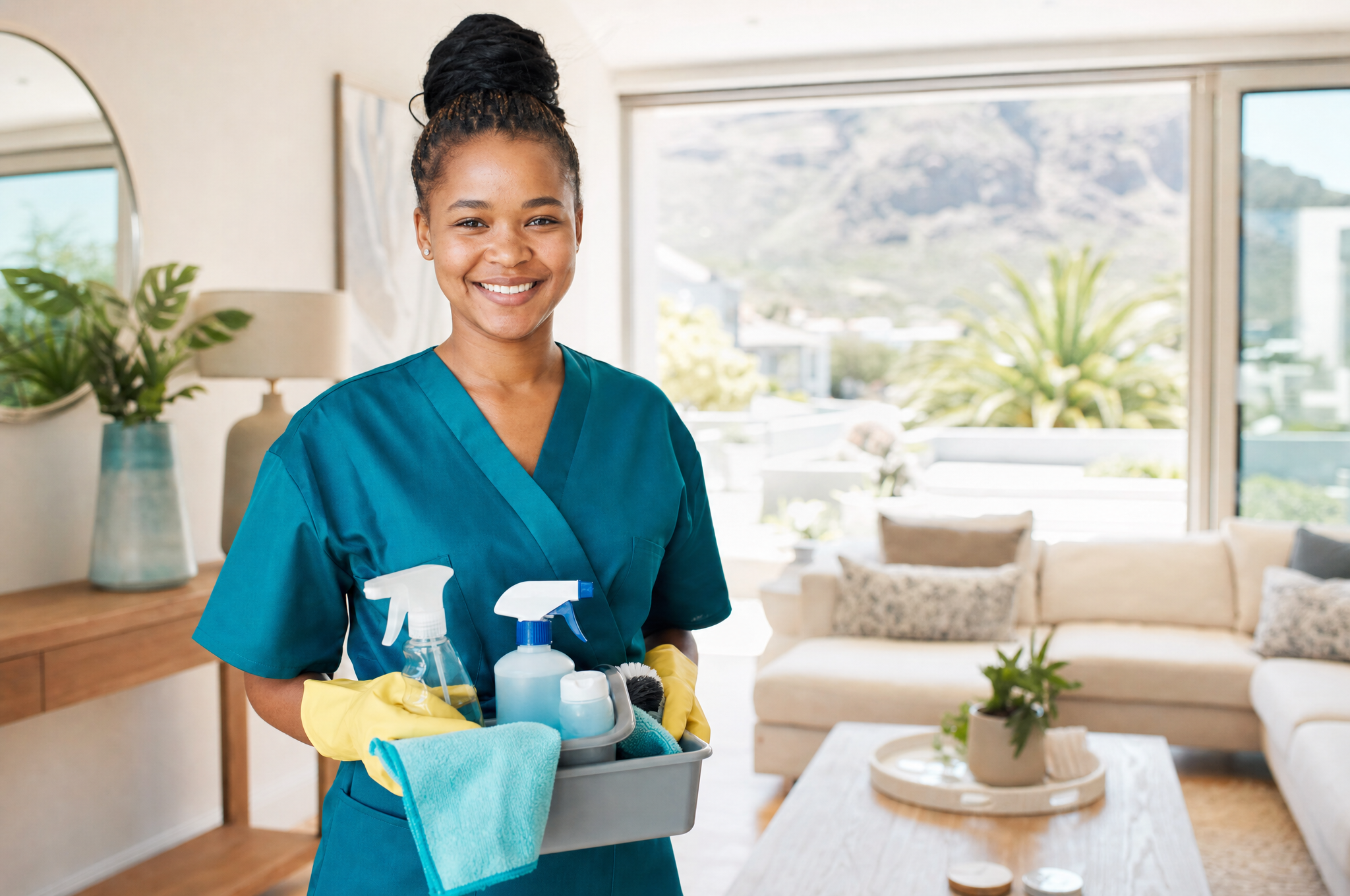
Starting a cleaning business in South Africa is one of the lowest-cost, fastest ways to build an income in 2026 — you can register a company for a few hundred rand and take your first client this week. There is no special cleaning licence required by law; you mainly need to register with CIPC, sort out tax with SARS, and price your work correctly.
Key facts
- No industry licence is needed to start cleaning homes or offices — cleaning is not a regulated trade in South Africa (Govchain).
- CIPC registration as a (Pty) Ltd needs just a valid SA ID, a physical address (not a PO Box), and an email — minimum one director (CIPC eServices).
- VAT only becomes compulsory once taxable turnover passes R1 million/year; below that you can stay unregistered.
- Typical domestic rates in 2026 sit around R63–R100/hour for regular cleaning, with once-off deep cleans averaging ~R500/hour (Procompare, LocalPros).
- NCCA registration is only mandatory if you plan to chase government or corporate tenders (Bekin Consulting).
Step 1: Decide what you'll clean
The cleaning market splits into a few clear lanes, and picking one keeps your marketing sharp:
- Domestic / residential — regular home cleans, the easiest entry point with the lowest startup cost.
- Once-off deep cleans — move-in/move-out, post-renovation, spring cleans. These pay the most per hour.
- Commercial / office — recurring contracts, higher value but usually needs staff and more compliance.
- Specialised — carpets, windows, upholstery, or post-construction cleaning.
Start with domestic or once-off work. It needs almost no capital, and happy clients refer you fast.
Step 2: Register your business
You can legally trade as a sole proprietor from day one, but registering a (Pty) Ltd with CIPC looks more professional and protects your personal assets. To register you need a valid South African ID for each director, a residential address, and an active email. There is no cleaning-specific permit — CIPC registration plus an income-tax registration with SARS is enough to start taking clients.
If you employ staff, you'll also need to register as an employer for PAYE, UIF and SDL, and comply with COIDA (workplace-injury compensation). Only chase NCCA registration and the Central Supplier Database (CSD) once you're going after tenders — for a first solo cleaner, skip it.
Step 3: Sort your kit and costs
Startup costs are refreshingly low. A realistic first shop:
- Core supplies: multi-surface cleaner, degreaser, bleach, glass cleaner, floor cleaner.
- Tools: mop and bucket, microfibre cloths, sponges, scrubbing brushes, a vacuum if you can afford one.
- Protective gear: gloves, aprons, sturdy shoes.
- Branding basics: a simple logo, a WhatsApp Business number, and a way to take payments.
Many domestic clients supply their own materials — note that cleaning without materials is priced lower (roughly R88–R165/hour) than with materials (R165–R330+/hour), so always confirm who provides what before you quote.
Step 4: Price it right
Pricing is where new cleaners lose money. Use the 2026 benchmarks as your floor, not your ceiling:
- Regular domestic: R63–R100/hour is the common range; independent cleaners often land R80–R220/hour depending on city and frequency.
- Once-off / deep clean: budget around R400–R600/hour — the work is harder and clients expect a spotless result.
- Per-day char rate: roughly R400–R800/day, averaging ~R600.
Charge more in Johannesburg, Cape Town and Sandton where demand and living costs are higher, and offer a small discount for weekly recurring clients to lock in steady income.
Step 5: Get clients (the part that actually matters)
Registration doesn't pay the bills — clients do. The fastest routes in 2026:
- WhatsApp and community groups — post in local neighbourhood and estate groups. Word of mouth is king in South Africa.
- Referrals — ask every happy client for one introduction. Offer a free add-on (like windows) for a successful referral.
- Online profiles — list on quote platforms and keep a simple portfolio of before/after photos.
- Join a cleaner network — platforms like CQD New Gen connect you directly with clients looking for cleaners, with no commission on what you earn and job posts that are always free for clients.
Consistency beats everything: show up on time, do thorough work, and follow up. A reliable cleaner in South Africa is never short of work.
Ready to get matched with clients and grow your cleaning income? Join free today 👉 www.cqdnewgen.ai
FAQ
Do I need a licence to start a cleaning business in South Africa?
No. Cleaning is not a regulated industry, so there is no specific licence, permit or accreditation required by law. You only need to register your business with CIPC and register for income tax with SARS before taking clients.
How much does it cost to register a cleaning company with CIPC?
CIPC company registration itself is inexpensive — often a few hundred rand directly through the CIPC eServices portal. Agencies charge more (packages can run into the thousands) for handling the paperwork, but you can do the basic registration yourself online.
What should I charge for cleaning in 2026?
Regular domestic cleaning commonly runs R63–R100 per hour, while once-off deep cleans average around R500 per hour. Rates rise in bigger cities and when you supply your own cleaning materials, so always confirm scope before quoting.
Do I need to register for VAT?
Only once your taxable turnover exceeds R1 million per year — then VAT registration becomes compulsory. Below that threshold you can operate without registering for VAT, which keeps admin simple for new cleaners.
How do I find my first cleaning clients?
Start with WhatsApp community and neighbourhood groups, ask happy clients for referrals, and list on cleaner-matching platforms. Reliability and before/after photos build trust fast, and one loyal client usually leads to several more.